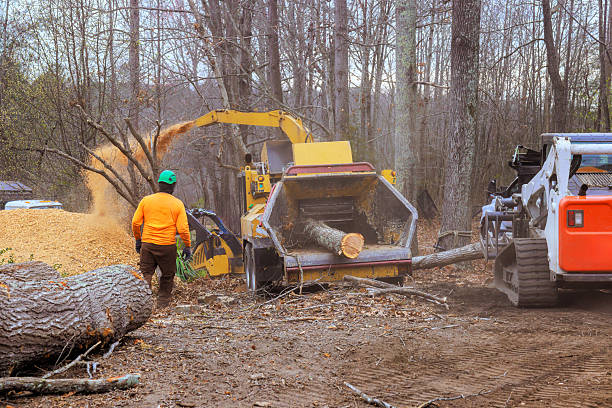
Homeowners trying to get a great deal on tree removal usually start by collecting quotes, and then get stuck: three companies, three very different numbers, no obvious way to tell which one is fair. The confusion disappears once you understand that a tree removal quote is not a single price but a stack of separate charges wearing a trench coat. Some of those charges are fixed by the tree itself. Others are choices — yours as much as the company’s — and that is where a good deal is actually made.
What a tree removal crew is really pricing
When an estimator walks your yard, they are mentally disassembling the job. The tree’s size and species matter, but access matters more: a tree that a bucket truck can reach from the driveway is a cheaper tree than the identical one behind a fence, over a pool, in a yard only reachable through a narrow gate. Everything that has to be carried out by hand adds labor. Targets matter too — the closer the canopy hangs to roofs, lines, and structures, the more of the tree has to come down in small, roped pieces instead of being felled in sections. Dead and decaying trees can cost more, not less, because they are unpredictable to climb. Understanding this explains the spread between quotes: companies are not always disagreeing about the price of the same job; sometimes they are picturing different jobs. The fix is to make every bidder price the same work, in writing — what comes down, what stays, and what the yard should look like when they leave.
The line items hiding inside the number
Ask for the quote itemized and the negotiation changes character. Stump grinding is frequently a separate line, and occasionally not included at all. Hauling is another: some prices assume every log and branch leaves on the truck, while others quietly assume the wood stays with you. Disposal fees, crane rental for restricted-access removals, and permit fees can each appear or vanish depending on the company. Once the parts are visible, you can make rational trades. Keeping the wood — as firewood, or chipped on site as mulch for your own beds — removes real cost from the crew’s day and is the most common honest discount in this trade. Taking over the light cleanup, the raking and sweeping after the heavy work, is another. What you should not trade away is the scope that protects you: if a line exists because the tree hangs over something valuable, that line is the job. A cheaper quote that plans to drop large sections near your roof is not cheaper in any sense that matters.
Timing is the discount you control
Tree crews price against their own calendars. Demand spikes after storms and through the busy growing season, when emergency work fills the schedule and planned removals wait their turn. In the quieter part of the year, the same companies compete harder for work, schedules open up, and a flexible homeowner — one who can say “any week this month” instead of “this Saturday” — is simply cheaper to serve. There is a second timing trick that costs nothing: neighboring jobs. A crew already working on your street has already paid the travel and setup cost for the day, so a removal added to the same visit is priced from a lower starting point. If your neighbors have been talking about their own trees, coordinating is worth real money to everyone involved. Our article on home safety and professional tree services covers the hazard side of deciding which trees genuinely need attention first, which helps if you are sequencing several jobs across a couple of seasons.
Two phone calls that can shrink the bill to zero — sometimes
Before paying anyone, check whether the tree is partly someone else’s problem. Trees threatening power lines are often the utility’s concern, at least for the portion near the lines, and many utilities will trim or remove in that zone at no charge to you. Municipalities also enter the picture: some cities require a permit for removing larger trees, some protect designated species, and some run programs for hazardous trees near public property. The rules vary enough that the only reliable move is a call to your local public works or urban forestry office before you sign anything — it can reveal a permit you needed anyway, or occasionally a program that shares the cost. While you are thinking about the trees near your lines, it is worth remembering what falling limbs do to outages; our piece on why people should consider getting a generator is the natural companion read for storm-prone properties.
Cheap is a paperwork question before it is a price question
Tree work sits near the top of the list of dangerous trades — OSHA maintains a dedicated tree care safety page for the industry precisely because the injury record demands it — and that danger is why the lowest bid deserves extra scrutiny rather than instant celebration. A legitimate company carries liability insurance and workers’ compensation, and can show you both; an uninsured operator’s lower price is lower partly because you are silently absorbing their risk. If an uninsured worker is hurt on your property, or a section of trunk lands on your neighbor’s fence, the savings arithmetic changes violently. Verify the business license, confirm the insurance certificates are current, and look for professional grounding: the Tree Care Industry Association represents commercial tree care companies, and the International Society of Arboriculture’s consumer site, TreesAreGood, explains how to find and vet a credentialed arborist. Get the agreed scope, price, and cleanup terms in a written contract. None of this raises the price — it simply ensures the deal you negotiated is the deal that shows up, which is the whole point. A great deal on tree removal is not the smallest number you were quoted; it is the smallest number that still buys a safe crew, a complete job, and a yard you recognize afterward. The same vet-first logic applies to other home emergencies, as our guide to emergency pest removal shows — urgency is exactly when paperwork matters most.