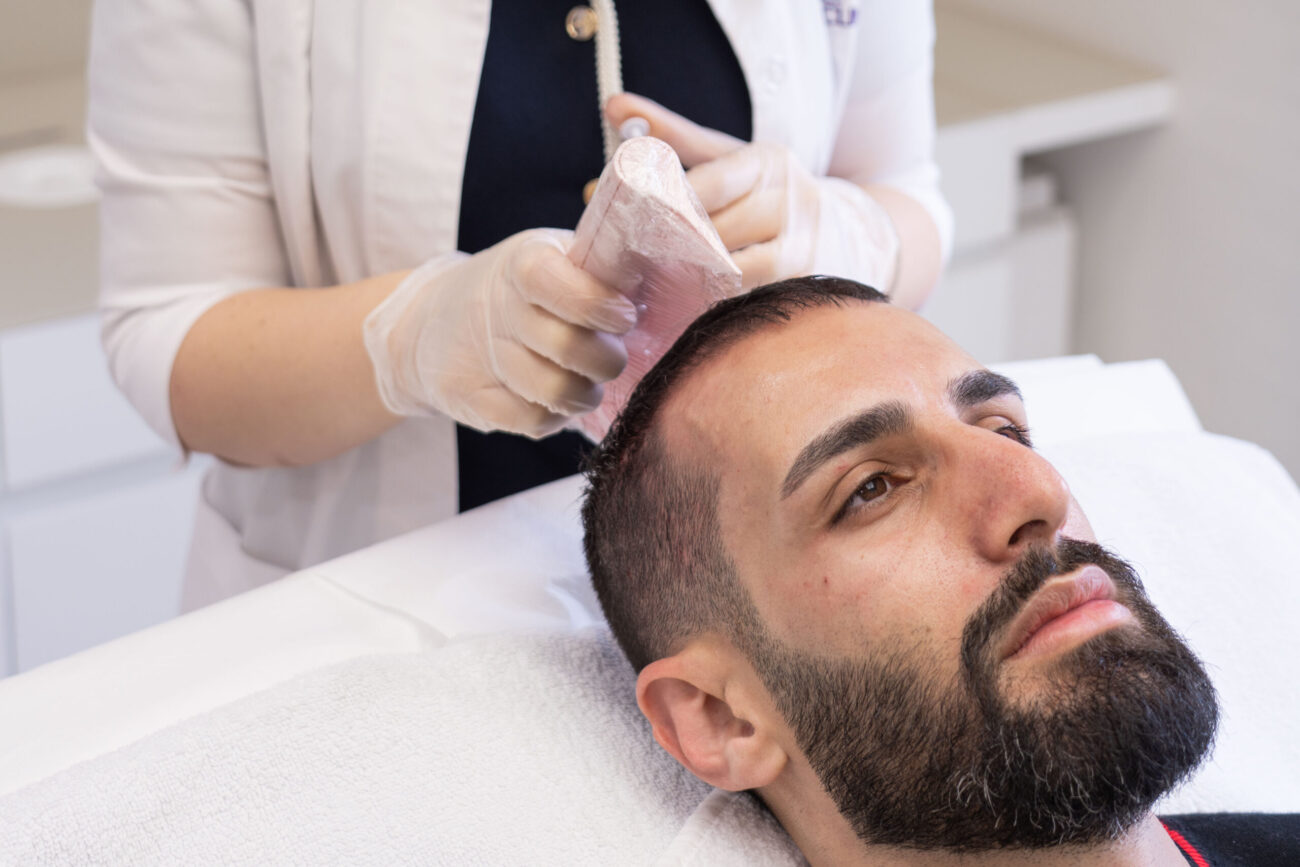
Every hair product on the shelf claims growth. Almost none of them have to prove it. Hair regrowth clinical trials are where proof is supposed to happen, and the proof turns out to be surprisingly blue-collar work: counting individual hairs in a marked patch of scalp, photographing the same head under the same lights for a year, and arguing honestly about whether what changed was the treatment or just the season. Understanding how that measurement works explains both why good hair treatments take so long to reach the market and why you should read miracle claims with a raised eyebrow.
Why hair is a hard thing to measure
Hair grows slowly, sheds in cycles, and responds to stress, illness, hormones and season. MedlinePlus’s overview of hair problems lays out how many different causes sit behind the same thinning mirror: inherited pattern loss, scalp conditions, medications, thyroid trouble, sudden shedding after a shock to the body. A treatment that helps one cause may do nothing for another, so a trial’s first job is diagnostic discipline — enrolling only the pattern of loss the treatment was designed for. The second job is patience. Follicles cycle over months, which is why serious studies run far longer than the six-week promises on a shampoo bottle.
The three research lanes of hair regrowth clinical trials
Current studies cluster into three lanes. The first is pharmacology: drugs applied to the scalp or taken by mouth that aim to keep follicles from shrinking under hormonal pressure, or to stretch the growth phase of the hair cycle. The second is procedural: platelet-rich plasma prepared from the participant’s own blood, microneedling, and transplant techniques being refined and compared. The third is devices, especially low-level light therapy caps and combs tested under controlled schedules. The American Academy of Dermatology maintains a useful map of which approaches dermatologists already use and which remain experimental — a good reality check before any trial brochure tempts you.
Counting: the target area and the photograph
The workhorse measurement is the target-area hair count. Researchers select a small, precisely located patch of scalp — sometimes marked with a tiny permanent dot — clip it, dye the hairs for contrast if needed, and count them in magnified images at the start and at set intervals. Alongside it sits global photography: the whole head, fixed lighting, fixed angles, later scored by reviewers who do not know which images came first or who received what. Neither method is glamorous, and that is the point. A treatment that adds a statistically real number of hairs in a counted patch has evidence. A treatment with dramatic before-and-after photos from a salon has marketing.
The comparison problem: placebos, vehicles and blindfolds
Hair trials have a subtle trap: the act of participating changes behavior. Volunteers massage in a study lotion daily, attend checkups, and take better care of their scalps — and the lotion base alone, the “vehicle,” can make hair look and shed differently. So well-run studies compare the active treatment against its own vehicle, applied identically, with neither volunteers nor evaluators knowing who got which. This is the same evidentiary machinery used in psoriasis clinical trials, another field where appearance, expectation and slow change make honest measurement difficult, and in Alzheimer’s disease trials, where outcomes take even longer to declare themselves.
Who gets in, and what participation actually involves
Expect screening to be picky: a defined pattern and duration of loss, a washout period away from other treatments, and exclusions for scalp disease or medications that would muddy the count. Participation then means months of scheduled visits, strict product rules — no new serums, dyes or supplements that could contaminate the result — and honest reporting of any side effects, from scalp irritation onward. In exchange, volunteers get specialist monitoring and, in many protocols, the study treatment and visits at no cost. Listings on ClinicalTrials.gov state each study’s criteria, locations and contacts; any program that guarantees results or charges entry fees is not running a trial, whatever it calls itself.
Endpoints: what success looks like on paper
Before the first volunteer is enrolled, a serious trial writes down exactly what it will count as success, and registers that definition publicly. The primary endpoint in hair research is usually the change in target-area hair count from baseline to a fixed week — a number, chosen in advance, that the statistics will judge. Secondary endpoints layer on the global photograph scores, measures of hair thickness, and the volunteers’ own ratings of coverage and satisfaction. This pre-commitment is what separates evidence from anecdote: a study cannot quietly swap its finish line after seeing the results, because the registry entry — visible on the same public listing where you found the trial — recorded the original one. When you read that a treatment “met its primary endpoint,” that dry phrase means the pre-registered count moved by a pre-registered amount. Everything else is commentary.
Reading the results like a researcher
When a study reports success, ask three questions. Compared to what — the vehicle, another drug, or nothing? By how much — hairs per target area is a real unit; “fuller-looking” is not. And in whom — results in one pattern of loss do not transfer automatically to another. This skepticism is not cynicism; it is the same standard applied in breast cancer clinical trials and everywhere else medicine separates hope from evidence. Hair loss is emotional, which is exactly why the counting has to be cold.